
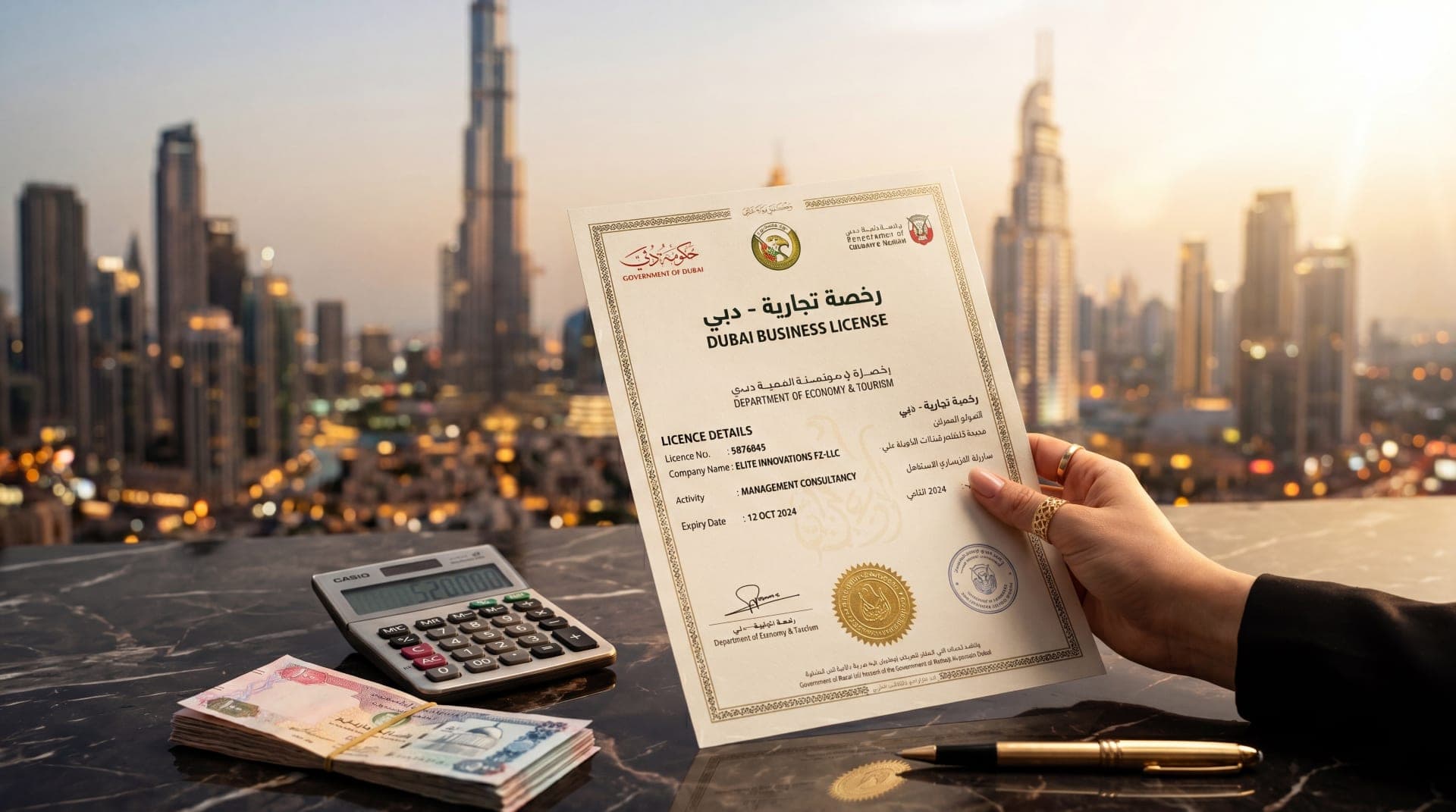
How Much Does It Cost to Start a Company in Dubai? (2026 Real Breakdown)
Luca Rubino
Business setup expert
Luca Rubino is the founder of Incorpify and a company setup expert specializing in the GCC and the United States.
A Dubai company costs anywhere from AED 5,000 to AED 50,000+ to set up in 2026, depending on jurisdiction, license type, visa needs, and office requirements. The cheapest legal route is a zero-visa free zone in Ajman or Sharjah at AED 5,000-5,750. A mainland LLC with a physical office and one investor visa typically lands between AED 30,000 and AED 50,000 in the first year. Most online "starting from" headlines hide AED 8,000-15,000 in mandatory add-ons that don't appear until you're past the point of switching providers.
This article breaks down the real, itemized cost of starting a company in Dubai across mainland and the seven most-used free zones. Government fee structures are published by the UAE government, the Dubai Department of Economy and Tourism (DET), and each free zone authority directly. Where consultancy fees apply, those vary by provider; typical service fees run from AED 5,000 (transparent providers) to AED 15,000+ (legacy consultancies). What follows is the math, line by line.
What Determines Dubai Company Setup Cost?
Five variables drive your final number. Get any of these wrong and your "AED 12,500 setup package" becomes an AED 35,000 invoice.
Jurisdiction. Mainland (DET) is the most expensive but gives you direct UAE market access. Free zones are cheaper, but you can only sell to mainland customers through a registered distributor, with caveats. Within free zones, Ajman, Sharjah, and Ras Al Khaimah are the cheapest (Ajman Free Zone, SHAMS, RAKEZ). Dubai-based free zones cost more but carry the Dubai address (IFZA, Meydan). DMCC and DIFC are in the premium tier.
License type. Commercial licenses (trading goods) cost more than professional licenses (services and consulting). General trading licenses cost the most because they cover unlimited product categories. Industrial licenses require physical premises and additional approvals.
Visa quota. Each visa adds AED 4,000–6,500 in government fees, plus the establishment card (AED 2,000–2,500) if you don't already have one. Most "zero-visa" packages skip this entirely, useful only if you don't need UAE residency.
Office requirement. Mainland mandates an Ejari-registered physical office, registered through the Dubai Land Department. Free zones often include a flexi-desk. Larger offices unlock more visas but add AED 12,000–50,000+ to your annual cost.
Service fees. What you pay your provider on top of government fees. This varies more than any other line item, anywhere from AED 0 (DIY through DET portal) to AED 25,000+ (legacy consultancies). The government fees are non-negotiable; the service fee is.
How Much Does a Dubai Mainland Company Cost in 2026?
A mainland setup goes through DET. Here's the typical first-year breakdown for a single-shareholder LLC with one investor visa:
Realistic mainland total for a one-shareholder, one-visa professional license with a small office: AED 30,000–45,000 in year one. A commercial license with general trading and a larger office can push past AED 60,000. Renewal in year two is typically AED 8,000–15,000 less because one-time setup fees (MOA, name reservation, initial approval) don't repeat, see our Dubai mainland license renewal guide for current renewal pricing.
Which Dubai Free Zone Is Cheapest in 2026?
Free zone packages are bundled differently from mainland. Most include the license, registration, and a flexi-desk in one package. Visas, an establishment card, and physical offices are extra.
These are the license fees only. To get a usable company with one investor visa and active immigration, add roughly AED 6,500–9,000 for the establishment card and visa processing on top of any zero-visa package. So a Meydan zero-visa license at AED 12,500 becomes AED 19,000–22,000 with one visa. SHAMS at AED 5,750 becomes AED 12,500–15,000 with one visa.
Visa Costs: The Same Across Jurisdictions
Whether you set up a mainland or a free zone, the federal visa process is identical. The only variation is who handles it (your free zone authority vs DET via GDRFA). Government fees per investor visa break down as follows:
Entry permit: AED 500–1,200. Status change (if already inside UAE): AED 600–1,000. Medical fitness test: AED 350–700. Emirates ID (2 years): AED 370. Visa stamping: AED 1,000–2,000. Health insurance (mandatory, 1-year basic plan): AED 800–2,500. Total per visa: AED 4,000–6,500.
For Golden Visa pricing and eligibility (10-year residency for investors AED 2M+ or salaried professionals AED 30K+/month), see our Dubai Golden Visa 2026 guide. Family sponsorship adds approximately AED 5,000–7,000 per dependent.
Office Costs: Where Most Budgets Break
Mainland legally requires a physical office with a registered Ejari tenancy contract. There is no "virtual office" workaround for mainland commercial activities. Some professional licenses qualify for DET-approved virtual office providers, but most need physical premises.
Realistic Dubai office rent in 2026: a small co-working desk runs AED 12,000–18,000 per year. A private office of 200–400 sqft in Business Bay or Barsha Heights costs AED 35,000–80,000 per year. Add the 5% Market Fee (DET charges 5% of annual rent on commercial premises, 20% on warehouses) plus AED 220 Ejari registration plus AED 500–1,500 in sustainability and waste management fees.
Free zones are far cheaper here. Most free zone packages include a flexi-desk (a shared workspace that satisfies the legal address requirement) at no extra cost or for AED 5,000–10,000 per year. DMCC is the exception; it requires a paid flexi-desk starting at AED 15,000–20,000, even on basic packages. Private offices in DMCC start at AED 35,000+.
Real Client Setup Examples
Three actual setups across different profiles. These are real budgets we've quoted, with government fees separated from service fees as we always do.
Solo Marketing Consultant (Italian, Setting Up Remotely)
Goal: UAE residency, one professional license, online client base in Europe. Chose IFZA professional license with 1 visa.
IFZA license + flexi-desk: AED 14,900. Establishment card: AED 2,200. Investor visa (entry permit, medical, Emirates ID, stamping, basic insurance): AED 5,500. Service fee (Incorpify flat rate): AED 5,000. Total year one: AED 27,600.
Two-Partner E-Commerce Trading Company
Goal: Trading license to import and resell consumer goods, two investor visas, Dubai address. Chose Meydan zero-visa license + 2 added visas.
Meydan trading license: AED 14,500. Establishment card: AED 2,200. Two investor visas (full package each): AED 11,000. Health insurance for 2: AED 3,500. Service fee (Incorpify, multi-visa setup): AED 5,000. Total year one: AED 36,200.
Mainland LLC for Local B2B Services
Goal: Mainland presence to bid on UAE government contracts, one shareholder, one visa, small private office. Chose DET commercial LLC with Ejari office.
Trade name + initial approval + MOA: AED 4,500. DET commercial license: AED 12,000. Establishment card + Ejari + Market Fee: AED 3,500. Office rent (small private office in Barsha): AED 28,000. Investor visa: AED 5,500. Health insurance: AED 1,500. Service fee (Incorpify, mainland setup): AED 5,000. Total year one: AED 60,000.
What Hidden Fees Do Most Articles Skip?
Six recurring costs that appear after the contract is signed:
Bank account opening assistance. Free zone companies struggle with UAE bank approvals. DMCC clients typically open accounts in 2–4 weeks; IFZA, Meydan, and SHAMS clients can wait 6–12 weeks. Many providers charge AED 2,000–5,000 separately for bank introductions and document support.
Corporate tax registration. Mandatory for every UAE company since June 2023, regardless of revenue. Registration with the Federal Tax Authority is free, but most consultancies charge AED 1,000–3,000 to handle it.
VAT registration. Required if your annual taxable revenue exceeds AED 375,000. Voluntary at AED 187,500. Free to register through the FTA portal; AED 1,000–2,500 if outsourced.
Translation and attestation. Foreign documents (degrees, marriage certificates, parent company documents for branches) need legal translation (AED 300–800 per document) and attestation through the UAE embassy + MOFA + Ministry of Foreign Affairs.
Accounting and bookkeeping. Corporate tax filing requires audited or reviewed financials. Outsourced bookkeeping starts around AED 800–1,500 per month for a small company. Annual financial statements add AED 3,000–8,000. Our accounting services bundle this with VAT and tax compliance.
Special activity approvals. Healthcare, food, real estate brokerage, education, and financial services need additional approvals (Dubai Health Authority, Dubai Municipality, RERA, KHDA, FSRA). These add AED 1,000–10,000+ depending on the activity.
Mainland or Free Zone for a New Dubai Company?
The decision is rarely about cost alone. Here's the practical framework:
Choose mainland if: you'll bid on UAE government tenders, you need to invoice UAE corporate clients directly, you operate retail with walk-in customers, you need a physical warehouse or industrial premises, or your business activity is restricted to mainland (legal, accounting, healthcare).
Choose a free zone if: your clients are international, you sell digital products or remote services, you don't need a physical office, you want the cheapest path to UAE residency, or you operate in commodities/crypto/specialized free zone activities (DMCC for trading, DIFC for finance, ADGM for fintech).
For UAE companies hiring employees, payroll rules are identical across mainland and most free zones, see our Dubai payroll and WPS guide for compliance details.
What Incorpify Actually Charges
Our service fees are flat and visible upfront. Setup of a free zone company with one visa: AED 5,000 service fee on top of government and free zone fees. Mainland LLC setup: AED 5,000 service fee on top of DET government fees. Multi-visa setups, branch office registrations, and complex structures (holding companies, JVs) are quoted separately.
Government fees are non-negotiable and we never mark them up. We tell you the real DET, GDRFA, and free zone authority numbers and pass them through at cost. The same approach applies to visa processing, free zone formation, mainland LLC formation, and ongoing compliance.
Frequently Asked Questions
What is the cheapest way to start a company in Dubai?
Is mainland or free zone better for a new company in Dubai?
How much does a UAE investor visa cost?
Do I need an office to start a company in Dubai?
What hidden fees should I budget for?
How long does it take to set up a company in Dubai?
Can I run a Dubai company from outside the UAE?
Explore More Articles
Dubai Mainland License Renewal: Government Fee Reductions Now in Effect
The Dubai DET deferred mainland trade license fees starting April 2026. Real client renewals have dropped from AED 17K to AED 12K. Here's what changed.
Read More
Dubai Payroll and WPS 2026: Rules, Deadlines, Penalties
The UAE Wage Protection System went real-time in December 2025. Missing a salary by 15 days triggers work permit freezes and AED 50K fines. How it works.
Read More
Dubai Golden Visa 2026: Who Qualifies, What It Costs, How to Apply
Every category, every fee, every step. The Golden Visa costs AED 4,000–6,500 to process. Here's who qualifies, how to apply in Dubai, and how to avoid rejection.
Read More